
Your Home Pool Safety Action Guide: Practical Tips to Keep Your Family Safe This Summer
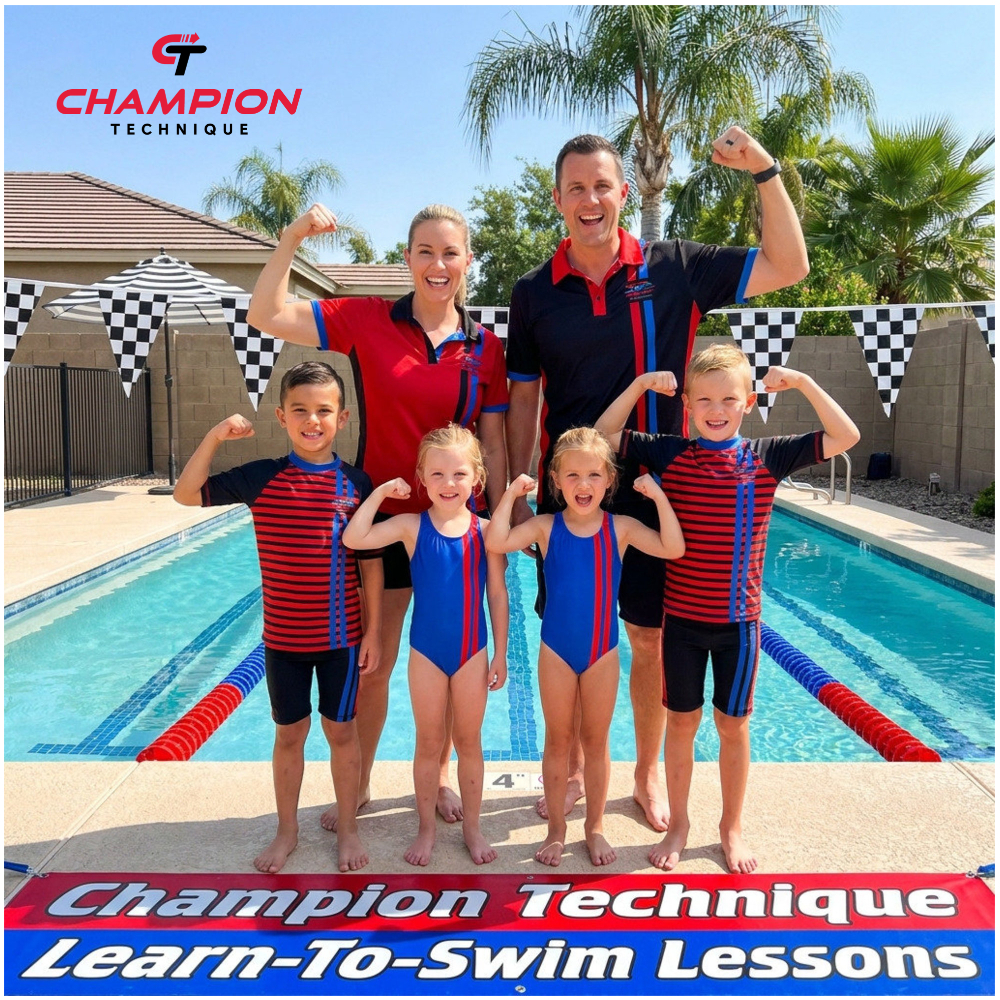
Your Home Pool Safety Action Guide
Practical Tips to Keep Your Family Safe This Summer
Because every moment with your family in the water should be filled with joy, not worry.
Hey Parker County families!
With summer just around the corner, we know you're excited about those backyard pool days, splash sessions, and water fun with your little ones. At Champion Technique, we're right there with you – celebrating every giggle, every splash, and every confidence-building moment in the water.
But here's the thing: we also want to make sure those moments stay joyful and safe. That's why we're sharing this practical, no-nonsense guide to keeping your home pool environment as safe as possible. Think of this as your family's water safety playbook – simple, actionable steps you can start implementing today.
Why Home Pool Safety Matters (And Why We're Talking About It)
We're not here to scare you – we're here to empower you. The truth is, most water-related incidents involving young children happen at home, often in backyard pools or even bathtubs. But here's the good news: most of these incidents are completely preventable with the right knowledge, habits, and preparation.
That's what this guide is all about: giving you practical tools to create a safer home water environment for your family.
The 3 Pillars of Home Pool Safety
Pillar 1: Practice Water Safety Drills (Yes, Really!)
You know how schools practice fire drills? Your family needs water safety drills too. These aren't scary – they're empowering practice sessions that build confidence and muscle memory.
Here's What to Practice:
The "Oops, I Fell In" Drill
- Practice with your child what to do if they accidentally fall into the pool
- Teach them to: Roll onto their back, float, and call for help OR swim to the nearest wall
- Make it a game: "Show me your superhero float!" or "Can you find the closest wall?"
- Practice this WITH your child in the water, not just talk about it
The "Pool is Closed" Rule
- Teach children that the pool area is OFF-LIMITS without an adult
- Practice what to do if they see a toy or ball in the pool (Answer: Get an adult!)
- Role-play scenarios: "What would you do if your favorite toy fell in the pool?"
Bathtub Safety Routines
- Create a consistent routine: Never leave the room, even "just for a second"
- Practice the "towel test" with toddlers: Can they stand up safely and get out with your help?
- Teach older siblings that bathtub duty is ALWAYS a grown-up job
The "Help!" Shout
- Practice calling for help loudly
- Teach kids the difference between pool play noise and emergency noise
- Make it a weekly game: "Emergency voice practice!" (Kids actually love this!)
Pro Tip: Practice these drills weekly, just like you'd practice any important skill. Make it fun, not frightening. Use positive reinforcement: "You're getting so good at your safety float! That's such an important skill!"
Pillar 2: Active Supervision – Every Single Time
This is where parents often think, "I know this already," but let's get specific about what effective supervision actually looks like.
What Active Supervision Really Means:
Designated Water Watcher
- Assign ONE adult as the official "Water Watcher"
- Use a visual marker (we suggest a special hat, lanyard, or even a brightly colored pool float)
- Rotate every 15-20 minutes to prevent attention fatigue
- When you're the Water Watcher, that's your ONLY job – no phone, no book, no distractions
Create a "Phone-Free Pool Zone"
- Establish a charging station AWAY from the pool area
- If you must have a phone nearby for emergencies, keep it in a waterproof bag and only check it during designated breaks when another adult takes over
Set the Right Pool Environment
- Keep background noise low enough to hear splashing patterns
- Know your child's "normal" water sounds vs. distress sounds
- If it gets too quiet, check immediately
The "Touch Supervision" Rule for Young Children
- For children under 4 and non-swimmers: You should be within arm's reach at all times
- This means IN the water with them, not sitting on the edge
- Yes, even in shallow water. Yes, even for "just a minute."
Know the Risk Levels:
- High Risk: Children 1-4, non-swimmers, new swimmers
- Medium Risk: Developing swimmers who can't yet swim 25 yards independently
- Lower Risk (but still needs watching!): Strong swimmers who can swim multiple laps
Activity Idea: Create a "Water Watcher" rotation chart with your family. Make special Water Watcher badges or hats that kids can help decorate. This makes supervision feel like a shared family responsibility.
Pillar 3: Layers of Protection
Think of pool safety like a lock on your front door – one layer is good, but multiple layers are better. Here's how to build your safety fortress:
Physical Barriers
Fencing (The Must-Have):
- Four-sided fence that completely separates the pool from the house
- At least 4 feet high with self-closing, self-latching gates
- Latch should be out of reach of young children
- Regularly check that gates close and latch properly
Pool Covers:
- When the pool isn't in use, especially off-season
- Must be a safety cover that can support weight (not just a solar cover)
- Always completely remove cover before pool use – never partially covered!
Door Alarms:
- Install alarms on all doors leading to the pool area
- Consider window alarms if windows open to the pool area
- Test monthly to ensure they're working
Water Alarms
- Surface wave detection alarms that sound when someone enters the water
- Wearable alarms for young children (worn as a bracelet)
- Consider submersible alarms as a backup layer
- Important: These are SUPPLEMENTS to supervision, never replacements!
Swimming Skills (Your Child's Personal Superpower)
Here's where we get excited! While swimming lessons are never a replacement for supervision, they ARE your child's best defense in an emergency.
What Quality Swim Lessons Should Include:
- Water safety skills first
- Self-rescue techniques appropriate for their age
- Practice in realistic scenarios (swimming in clothes, entering water unexpectedly)
- Graduated skill-building with personalized attention
At Champion Technique, our 1:1 instruction means every swimmer gets focused attention on the skills that matter most for their safety level. We're not just teaching strokes – we're teaching life-saving water competency.
Environmental Safety Checks
Monthly Pool Area Safety Audit:
- Remove or secure pool toys when not in use (they attract kids to the water)
- Keep furniture away from fences (no climbing assists!)
- Ensure drain covers are secure and in good condition
- Check that rescue equipment is accessible (life ring, reaching pole)
- Verify that CPR instructions are posted and current
Emergency Preparedness
- Post CPR instructions in the pool area
- Keep a charged phone in a waterproof case nearby (for emergencies only!)
- Teach all adults in the home CPR – take a refresher course annually
- Have emergency numbers visible (911, poison control)
- Know the address of your nearest emergency room
Age-Specific Safety Tips
For Babies and Toddlers (0-3 years)
- Bathtub: NEVER leave them alone, even in a baby bath seat. Drowning can happen in less than 2 inches of water.
- Pool time: You should be in the water with them, within arm's reach
- Practice: Hold them on their back in the water to build comfort with floating
- Start lessons: Many programs (including ours!) offer parent-child classes for babies as young as 6 months
For Preschoolers (3-5 years)
- Independence: They may THINK they can swim independently – they can't. Maintain touch supervision.
- Practice: Work on back floating and reaching the wall from various distances
- Pool rules: Establish and repeat clear rules: No running, no pushing, ask before getting in
- Lessons: Focus on water safety skills and basic swimming competency
For Early Elementary (5-8 years)
- Skill assessment: Can they swim 25 yards independently? If not, they still need close supervision
- Practice: Deep water skills, treading water, swimming in clothes
- Responsibilities: They can start learning to be junior water watchers (with adult supervision)
- Lessons: Building endurance, refining strokes, advanced safety skills
For Older Kids (8+ years)
Independence: If they're strong swimmers, they may have earned some pool freedom – but supervision is still required
- Buddy system: No one swims alone, ever
- Practice: Rescue skills, helping younger swimmers, leadership in safety
- Responsibilities: Can be CPR certified, can help younger siblings learn safety rules
Creating Your Family Water Safety Plan
Let's put this all together into a plan you can actually use:
This Week:
- Walk your pool area and identify any safety gaps
- Schedule a family meeting to discuss pool rules
- Practice one water safety drill with your kids
- Designate or create a "Water Watcher" system
This Month:
- Check all fences, gates, and alarms
- Take (or refresh) your CPR certification
- Schedule swimming lessons if your child isn't enrolled
- Create your family's pool rules poster (have kids help design it!)
This Summer:
- Practice water safety drills weekly
- Maintain consistent supervision standards – no exceptions
- Check in mid-summer: How are your safety habits holding up?
- Celebrate progress: Notice how your child's swimming skills are growing!
The Champion Technique Difference
At Champion Technique, we're not just teaching swimming – we're building water safety skills that could save your child's life. Here's what makes our approach different:
✅ Personalized 1:1 instruction – Every child gets focused attention on their specific needs
✅ Safety-first curriculum – We teach self-rescue and water safety skills from day one
✅ Community commitment – We track local, state and national drowning prevention as a measure of our success
We regularly hear from families that the skills their children learned in our program prevented a tragedy. That's not just teaching swimming – that's empowering families and saving lives.
Your Next Steps
Here's the truth: You're not reading this because you're a careless parent. You're reading this because you CARE deeply about your child's safety. That care, combined with action, is what keeps kids safe.
Here's what to do right now:
- Choose ONE tip from this guide to implement today (don't overwhelm yourself – start small!)
- Schedule your water safety drill for this weekend
- Check your pool barriers – are all gates latching properly?
- Assess your child's swimming skills – are lessons needed?
And if you're ready to give your child the gift of water safety skills and swimming confidence, we'd love to help. Our summer slots are filling quickly, and we want to make sure every child in Parker County has the skills they need to be safe in and around water.
Ready to take action? Visit championtechnique.com or call us today to schedule your child's swim assessment.
Remember: You've Got This!
Every stroke your child takes brings them closer to water safety confidence. Every safety drill you practice builds crucial muscle memory. Every layer of protection you add makes your home pool environment safer.
We're not just a swim school – we're your partners in keeping Parker County families safe in the water. Let's make this summer the safest, most confidence-building one yet!
Together, we're creating a safer, stronger community – one swimmer at a time.
Have questions about water safety or swimming lessons? Drop them in the comments below or reach out directly at championtechnique.com.
We're here to help!
P.S. Share this guide with other parents in your community. Water safety knowledge is something we should all have access to. Let's keep Parker County families safe together!
 Sed lorem volutpat. Sapien platea lorem metus leo. Elit fusce odio consectetur. Congue primis nullam sem libero cursus fermentum laoreet? Platea torquent litora lobortis integer congue nunc aliquam a nibh congue fringilla! Dapibus tristique euismod etiam condimentum hac tempor! Hendrerit vulputate bibendum ac facilisis, leo ac fermentum. Nisi tempor tortor maecenas ullamcorper, augue tristique. Massa.
 Potenti est suspendisse, accumsan integer ut augue! Turpis ligula cras, dui enim quisque? Pulvinar justo a vulputate nam etiam, iaculis duis. Felis eleifend inceptos mattis. Aliquet dapibus eros habitasse sociosqu eget faucibus! Imperdiet ullamcorper ornare litora fringilla conubia praesent tempus! Ut commodo class libero? Vulputate litora ut cubilia luctus. Leo fusce auctor fusce. Pharetra taciti dapibus ut bibendum mollis at, purus congue ornare, euismod porta. Quam habitasse sem mattis libero? Nec bibendum congue ad cubilia donec lacus libero! Sed ut tellus pellentesque etiam venenatis, duis ligula blandit. Elementum volutpat lacus sagittis, class tempor auctor. Nec accumsan consequat gravida ornare sed? Egestas laoreet.
