
Wait An Hour After You Eat
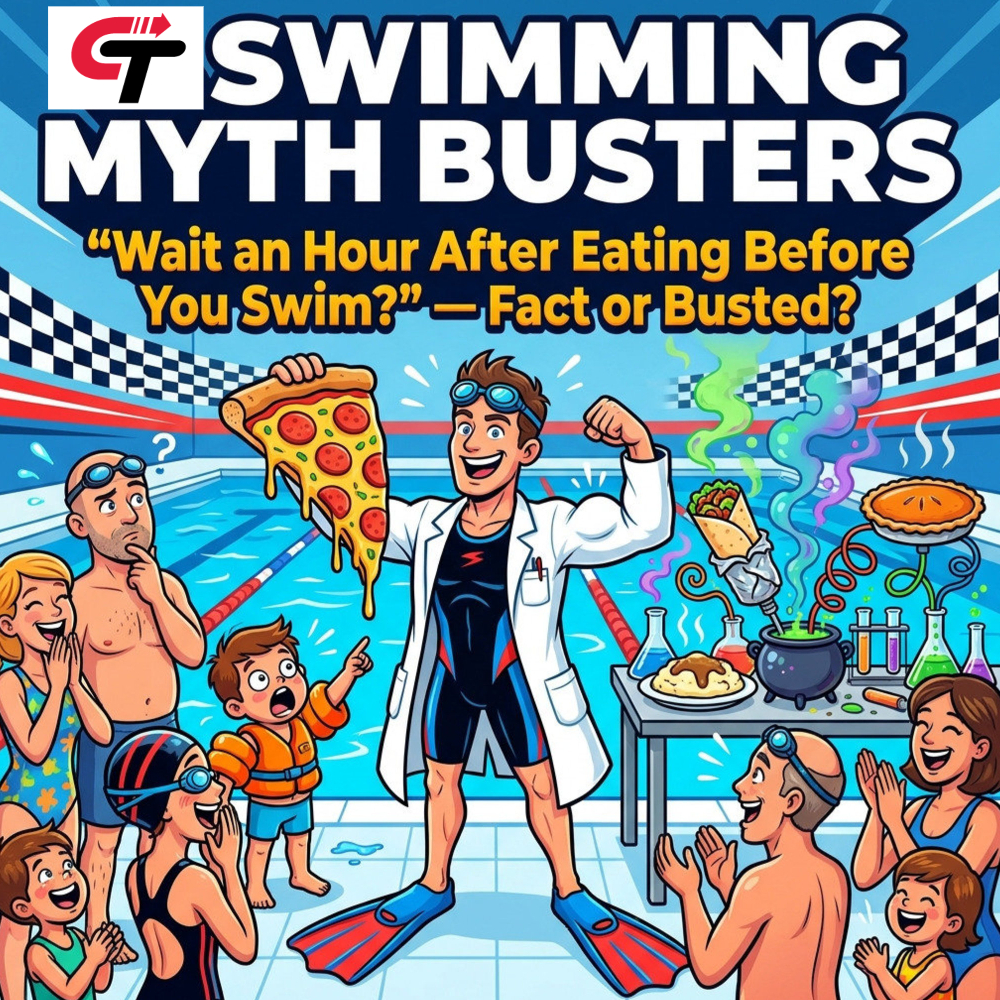
SWIMMING MYTH BUSTERS: "You MUST Wait an Hour After Eating Before You Swim!"
Brought to You by Champion Technique
THE MYTH: "Don't you dare get in that pool — you just ate! Wait a full hour or you'll get cramps and drown!"
Sound familiar? If you've ever sat poolside, stomach full, staring longingly at the water while your sandwich slowly digested — you've been a victim of one of the most legendary swimming myths of all time.
Today, Champion Technique is suiting up, grabbing a clipboard, and diving headfirst into the science to find out once and for all: Is this rule real — or is it completely busted?
WHERE DID THIS MYTH COME FROM?
Before we run a single experiment, let's travel back in time — way back to the early 1900s.
Picture this: It's 1908. The British Boy Scout manual, Scouting for Boys, has just been published. Inside, nestled between lessons on knot-tying and campfire building, is a stern warning:
Do NOT swim after eating. The manual warned that digesting food diverted too much blood to the stomach, causing "paralyzing cramps" that could lead to drowning.
Three years later, in 1911, the Boy Scouts of America handbook picked up the same warning and spread it across the United States like wildfire. Millions of parents, coaches, and lifeguards repeated it. Grandmothers enforced it with iron fists. Poolside timers were set. Sandwiches were rationed.
Entire summer afternoons were lost.
The theory went like this:
When you eat, your body sends extra blood to your stomach to help digest food. That means less blood goes to your arms and legs. Less blood in your limbs = muscle cramps. Muscle cramps in the water = DANGER.
It sounds almost logical. Almost.
But here at Champion Technique, we don't accept almost. We test it.
So we designed three experiments — with three very different swimmers — to find out the truth.
EXPERIMENT #1: THE GREAT PIZZA PLUNGE
"Can a Beginner Swimmer Survive a Slice?"
The Setup:
Our first test subject: 7-year-old Timmy, a brand-new swimmer who just completed his very first week of swim lessons. Timmy's superpower? An absolutely legendary appetite and zero fear of anything.
Timmy was given one full slice of pepperoni pizza — extra cheese, because science demands accuracy — and asked to wait exactly zero minutes before entering the pool.
Timmy's mom, Linda, stood at the pool's edge, arms crossed, phone in hand. She wasn't sure who she was going to call. Maybe the pizza place.
The Experiment:
Timmy finished his pizza, wiped his hands on his swim trunks (noted with a grimace), and jumped into the shallow end.
We monitored:
- Energy levels
- Arm and leg coordination
- Any signs of cramping
- Any signs of nausea (the potentially gross variable — you've been warned)
- Overall happiness levels (critical data point)
What Happened:
Timmy swam for 22 minutes straight. He kicked. He splashed. He attempted a freestyle stroke that could generously be described as "enthusiastic."
At no point did Timmy cramp. At no point was Timmy in distress. He DID ask for another slice of pizza when he got out.
The only casualty of the experiment was a small piece of pepperoni that fell into the pool filter. It was documented as "collateral evidence."
Linda uncrossed her arms somewhere around minute 8.
The pizza stayed where it belonged. The myth took its first hit. But we weren't done yet.
EXPERIMENT #2: THE BURRITO BUTTERFLY CHALLENGE
"What Happens When an Intermediate Swimmer Goes Full Chipotle?"
The Setup:
For Experiment #2, we needed to raise the stakes considerably. Enter 13-year-old Maya, a competitive swimmer on her local swim team with five years of experience. Maya was confident, fast, and — crucially — very hungry.
Maya was presented with two full burritos (swimmers can eat): rice, beans, chicken, cheese, sour cream, guacamole, and salsa. The kind of burrito that requires two hands and a personal commitment, she had 2. Maya ate both in 11 minutes total. We timed it. We were impressed.
Maya was then asked to swim 200 yards of butterfly — immediately after finishing the burritos.
Maya's swim coach, Coach Rivera, watched poolside with the expression of a man who had seen too much already. "This is going to be a disaster," he muttered. We wrote that down.
The Experiment:
Maya pushed off the wall and began her butterfly. We monitored:
- Lap times compared to her personal average
- Leg kick strength and consistency
- Breathing patterns
- Any dizziness or discomfort
- Whether the burritos made a reappearance (we warned you again)
What Happened:
Maya completed her 200 yards of butterfly. Her times were approximately 4 seconds slower than her personal average.
There were no cramps. There was one moment around lap three where Maya paused at the wall and said, "I feel like a water balloon," which was documented as anecdotal evidence of fullness — not a medical emergency.
Coach Rivera slowly nodded from the bleachers. He did not apologize for his earlier prediction.
The burrito stayed exactly where it belonged.
Two experiments in. Two swimmers are fine. But we needed one final, definitive test.
EXPERIMENT #3: THE THANKSGIVING TRIATHLON
"Can an Adult Recreational Swimmer Survive the Ultimate Food Coma Challenge?"
The Setup:
This was the grand finale. The experiment we had been building toward.
We recruited 45-year-old Dad-Swimmer Dave — a recreational former competitive swimmer who swims three times a week, considers himself "pretty solid," and owns at least four pairs of swim goggles but can never find any of them when he needs them.
Dave was given what we called "The Thanksgiving Plate":
- A full serving of roast turkey
- Mashed potatoes with gravy
- Green beans (for scientific credibility)
- Two dinner rolls
- A slice of pumpkin pie
Dave ate everything (as much as he wanted). He loosened his swim trunks drawstring. He sat for exactly three minutes — the time it took us to get our clipboards ready — and then he got in the pool.
Dave's wife, Karen, filmed the entire thing. Their two kids cheered from the bleachers, mostly because they were fairly certain Dad was about to embarrass himself spectacularly (either front or back, or both).
The Experiment:
Dave was asked to swim for 30 minutes — a mix of freestyle and breaststroke — at a moderate pace.
We monitored:
- Breathing comfort
- Leg cramping (the mythological culprit)
- Nausea levels (the potentially gross finale — last warning)
- Overall swimming performance
- Dave's pride levels
What Happened:
Dave completed his 30 minute swim. He was, by his own admission, "uncomfortably full" after 5 minutes in. His breaststroke became what we diplomatically described as "a gentle undulation." By 10 minutes, he was breathing harder than usual.
He did not cramp. He did not drown. He surfaced after 12 minutes and announced, "I need to lie down," which was documented as a lifestyle choice, not a medical symptom.
The green beans were, everyone agreed, completely unnecessary.
Karen's video got 47 likes on the family group chat.
THE VERDICT IS IN
After three experiments, three very full swimmers, one pepperoni-filter incident, and more clipboard notes than we care to admit — the results are clear:
💥 MYTH: BUSTED! 💥
The "wait an hour before swimming" rule is a well-meaning but scientifically unfounded myth born from early 1900s Boy Scout manuals — not from medical research, not from documented drowning cases, and not from anything your body actually does.
THE SCIENCE BEHIND WHAT WE JUST WITNESSED
Three experiments. Three very different swimmers. Three very full stomachs. And not a single paralyzing cramp in sight.
So what's actually going on inside the body?
Here's what the science tells us:
The myth assumes the body works like a simple plumbing system — that blood can only go to ONE place at a time, and if your stomach calls dibs, your arms and legs are left high and dry.
The reality? Your cardiovascular system doesn't work that way. When you eat, your body simply increases its cardiac output — pumping more blood overall — to supply both your digestive system AND your working muscles simultaneously. Your body doesn't have to choose. It just does more.
✅ The American Red Cross has confirmed that eating before swimming does NOT increase your risk of drowning.
✅ The Mayo Clinic agrees — there is no medical evidence supporting the one-hour rule.
✅ Zero documented cases exist of anyone drowning because they swam after eating.
Zero. Zilch. Nada.
What DID our experiments show? That swimming on a very full stomach can make you feel sluggish and uncomfortable — as Maya and Dave both discovered. But uncomfortable is a very long way from dangerous.
The practical truth for swimmers and swim families:
- Light snack before swimming? You're completely fine. Go for it.
- Moderate meal before swimming? You might feel a little sluggish. That's it.
- Full Thanksgiving feast before swimming? You'll be uncomfortable — but not in danger. Maybe ease up on the butterfly.
- Competitive swimmers eat strategically before races and training all the time. Ask any coach.
The only thing you should truly wait for? Waiting to share this post with every parent who has ever made their kid sit on a towel for an hour staring at the pool.
WANT MORE MYTHS BUSTED?
We're just getting started. There are plenty more swimming myths lurking out there — and Champion Technique is coming for every single one of them, clipboard in hand.
Sign Up for the Swimming Myth Busters Newsletter!
Get the truth delivered straight to your inbox — no waiting required.
Every issue features:
- A brand-new myth put to the test
- Real science explained in plain, fun language
- Tips and insights for swimmers and swim families
- Experiments that are equal parts educational and entertaining
Join swimmers and swim families across the community who are done letting myths run their pool time.
👉 YES! COMPLETE THE FORM BELOW TO REGISTER FOR SWIMMING MYTH BUSTERS → Because life's too short to sit on the pool deck waiting for nothing.
Have a swimming myth you want us to investigate next? Email contactus@championtechnique.com — we're always looking for our next experiment.
Tag a swim parent who made you wait an hour at the pool. They owe you a swim.
