
The Power Of Underwater Dophin Kicks
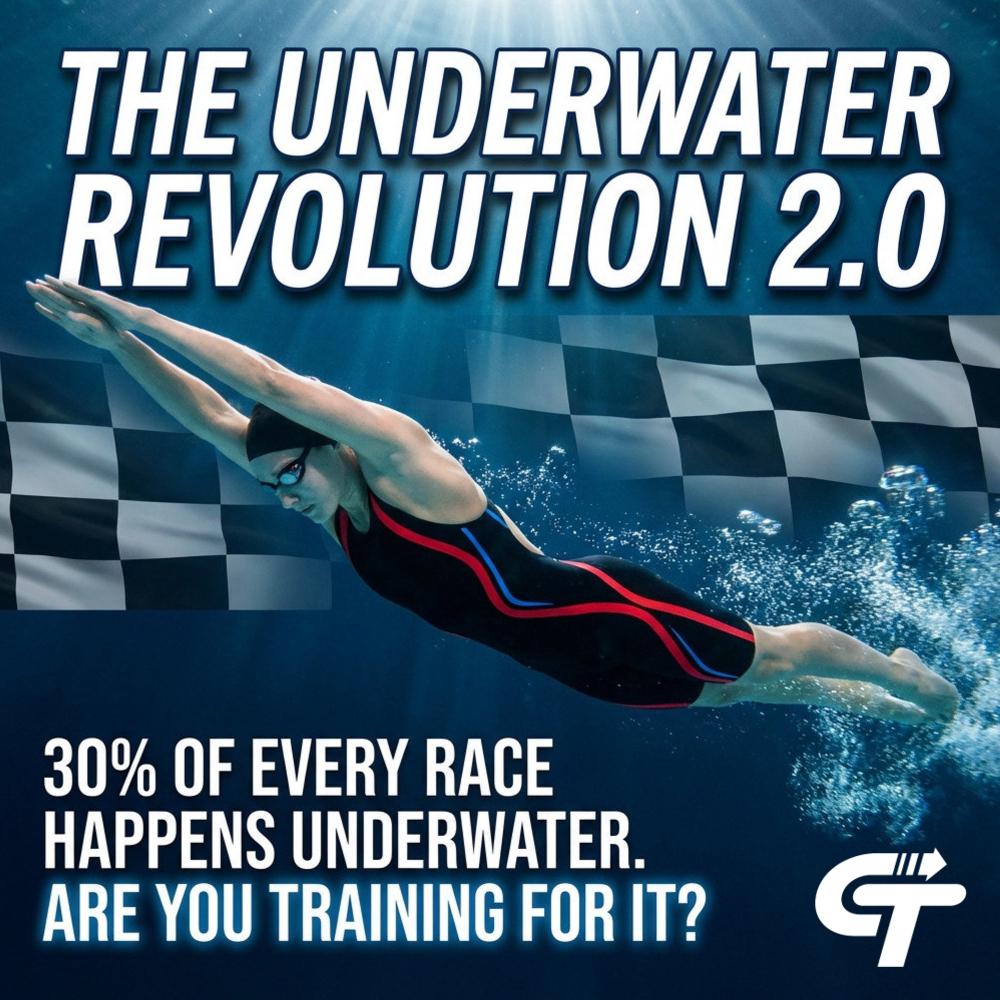
The Underwater Revolution 2.0: When the Fastest "Stroke" Isn't a Stroke at All
Picture this: It's the 2028 Olympics in Los Angeles. The 100-meter butterfly final. Eight of the world's fastest swimmers are on the blocks. The gun fires. They explode off the start, slicing into the water like torpedoes.
But here's what makes your jaw drop: Twenty seconds into the race, the leader has barely swum ten strokes of actual butterfly. Instead, they've dominated underwater—streamline dolphin kicking at speeds that their own freestyle can't match. The crowd goes wild watching the underwater cameras capture this aquatic ballet of power and precision. This isn't a novelty act. This is the future of competitive swimming.
Welcome to the second wave of swimming's underwater revolution.
REMEMBER: Competitive swimming boils down to one simple truth - RACING ("I'm faster than you." But what does that mean? This is one of Champion Technique's study to Racing In Swimming.
A History Lesson: We've Been Here Before
Let's rewind the clock 25+ years. The 1990s and early 2000s saw swimmers like Denis Pankratov revolutionizing butterfly by dolphin kicking nearly the entire 50-meter pool—underwater. Then they'd turn and do it again. Some races saw athletes spending 90% of their time underwater, dolphin kicking instead of actually swimming the prescribed stroke.
It was incredible to watch. It was also controversial.
Streamline dolphin kicking had become the second-fastest way to move through water, beaten only by sprint freestyle. But here's the thing: if swimmers were dolphin kicking through most of the butterfly, were they really swimming butterfly? Purists argued the sport was losing its identity. Race officials worried about safety. The solution? Rule changes.
Swimming's governing bodies implemented the now-famous 15-meter rule: swimmers could only remain underwater for 15 meters after starts and turns. The rule forced athletes back to the surface, back to swimming the actual strokes, back to the traditional sport.
Crisis averted. Balance restored.
Or so we thought.
The Game Has Changed: Faster Than Freestyle
Fast-forward to today, and we're facing something even more significant: Elite swimmers can now streamline dolphin kick faster than they can sprint freestyle.
Read that again. The absolute fastest stroke in competitive swimming—sprint freestyle—is being outpaced by streamline dolphin kicking. This isn't about a few specialized athletes. We're seeing this at the highest levels of competition, with Olympic swimmers posting underwater splits that exceed their surface speeds.
The implications are staggering.
Every start is an opportunity to build a body-length lead. Every turn is a chance to extend or erase a gap. In a 100-meter race with one turn, you have two 15-meter segments where you can move faster than your competition is capable of swimming—if you've trained for it.
But here's where it gets even more complex: USA Swimming has implemented restrictions on breath control training as a safety response to hypoxic training-related incidents. While these guidelines protect swimmers, they create an interesting competitive dynamic.
Swimmers who naturally excel at underwater dolphin kicking—or who trained extensively before these restrictions—now possess a massive, potentially insurmountable advantage. They can utilize those 15-meter underwater zones at maximum capacity while others are limited by breath control they haven't been able to train as intensively.
We're witnessing a paradigm shift in competitive advantage.
The Training Dilemma: Practice The Way You Want To Compete
At Champion Technique, we live by a core philosophy: "Practice The Way You Want To Compete, because You WILL Compete The Way You Practice!"
This principle has never been more relevant—or more challenging to apply.
Think about the math: In a 50-meter race, you get 15 meters off the start. That's 30% of the race. In a 100-meter race with one turn, you get two 15-meter segments—that's 30% of the entire race. In a 200-meter race? Four 15-meter segments equal 60 meters, or 30% of the event.
Thirty percent of every race happens underwater.
Now consider this: If you're spending 30% of your race in streamline dolphin kicking, shouldn't you spend roughly 30% of your practice training that skill with the same intensity and precision you'll need in competition?
Yet look around most pool decks. How much time do swimmers really dedicate to perfecting their underwater work? How often do they pop up at 8 meters instead of pushing to 12? How many practice walls are executed with championship-level commitment versus going through the motions?
Here's the uncomfortable truth: If you practice lazy streamlines, rushed underwater phases, and premature breakouts for months, your body won't magically know how to execute perfect 15-meter underwater segments when the championship meet arrives.
You WILL compete the way you practice. Your muscle memory, your breath control, your explosive power—all of it is programmed by what you do thousands of times in training, not by what you wish you could do on race day.
The Competitive Edge: Building Your Underwater Dominance
So how do you build championship-level streamline dolphin kicking? The same way you build any elite skill: with intentional, progressive, relentless training.
1. Perfect Your Streamline Position—Every Single Time
- Arms locked overhead, biceps squeezing ears, hands stacked
- Core engaged like a steel rod, body in one straight torpedo line
- Hips at surface, head neutral, toes pointed
Practice Principle: Execute perfect streamline off EVERY wall in practice. No exceptions. No shortcuts. No "saving it for the meet." If you want race-quality streamlines, train race-quality streamlines. Practice The Way You Want To Compete, because You WILL Compete The Way You Practice!
2. Master the Dolphin Kick Wave
The dolphin kick is a full-body undulation that starts in your chest:
- Press chest down → Hips rise
- Drive hips down → Chest rises
- The wave culminates in explosive kick from straight legs and pointed toes
Practice Principle: At Champion Technique, we emphasize "LEGS FIRST! This powers EVERY quarter of your race!" Dedicate specific sets to feeling the chest-press-to-hip-drive connection. Video yourself underwater. Study elite swimmers. Practice the pattern until it becomes automatic. Build rounds: power kicks, race-pace kicks, sprint kicks when fatigued.
3. Build Lung Capacity and Breath Control
Within current USA Swimming guidelines, maximize your underwater capacity through progressive training:
- Week 1: Commit to 10 meters off every wall
- Week 2: Push to 12 meters
- Week 3: Challenge yourself to 15 meters
- Track your progress religiously
Practice Principle: Consistency builds capacity. Your body adapts to the demands you place on it—but only if those demands are consistent and progressive. Train your body to perform in the oxygen-depleted state you'll experience in the final 50 of a championship race. Practice The Way
You Want To Compete!
4. Train Race-Pace Intensity
This is where most swimmers lose the advantage. They dolphin kick at 60-70% effort in practice, then wonder why they can't execute at 95% in the finals.
Practice Principle: Designate specific sets as "race simulation" underwater work. During these sets:
- Kick at 85-95% intensity
- Maintain streamline discipline even when fatigued
- Time yourself—create benchmarks and chase them
- Feel what championship-level underwater swimming demands from your body
If your practice underwaters don't challenge you, they won't prepare you. You WILL compete the way you practice!
5. Strategic Kick Counting
Elite swimmers know exactly how many kicks they can execute before breaking out. It's not random—it's calculated.
Practice Principle: Count your kicks off every wall. Find your optimal number (typically 8-14 kicks depending on distance and lung capacity). Practice hitting that number consistently. Know your capability so you can race with confidence instead of guessing.
6. Explosive Breakouts
A poor breakout erases all the advantage you earned underwater.
Practice Principle: Train your breakout with the same intensity as your underwater phase. Drive forward powerfully, maintaining momentum. Your first stroke should feel like a continuation of your underwater speed, not a restart. Power, Precision, Performance—all three elements must come together in your breakout.
The Future of Swimming: Five Scenarios for 2028 and Beyond
So where is this all heading? Let's explore some fascinating—and potentially controversial—possibilities for the sport's future:
Scenario 1: The Underwater Specialist Emerges, Again
By 2028, we might see swimmers who are "underwater specialists"—athletes who dedicate extraordinary training time to streamline dolphin kicking, building lung capacity and underwater speed that gives them 1-2 second advantages in every race.
These athletes might not have the fastest freestyle or butterfly stroke, but their underwater segments are so dominant that they win races by maximizing the 30% of the race where they're unstoppable. Imagine a swimmer winning the 100 butterfly with the fifth-fastest butterfly stroke in the field, but the fastest underwater in the world.
Training Implication: Coaches might spend 30-40% of practice time on underwater work—not as warm-up or afterthought, but as primary training. Practice The Way You Want To Compete means prioritizing what wins races, and increasingly, that's underwater excellence.
Scenario 2: Rule Changes—Do We Limit It Further?
Swimming's governing bodies could respond by reducing the 15-meter rule to 10 meters or even 5 meters, forcing swimmers back to swimming the actual strokes sooner.
But here's the counterargument: Streamline dolphin kicking is incredible to watch. Those underwater cameras capturing the raw power and technique? That's compelling television. That's highlight-reel material. In an era where swimming competes for viewers and engagement, the underwater phase might be the most exciting part of races.
Plus, if streamline dolphin kicking is legitimately the fastest way to move through water, isn't limiting it like handicapping athletes for being too good?
Scenario 3: The Creation of Underwater Events
What if, instead of limiting underwater dolphin kicking, we celebrated it? Imagine new events:
- 50-meter Underwater Streamline Dolphin Kick
- 100-meter Underwater (with turns)
- Mixed relay incorporating underwater segments
These could become standalone events, showcasing a skill that's already fundamental to swimming while creating new competitive opportunities.
Underwater swimming is mesmerizing to watch—why not give it its own spotlight?
Scenario 4: Technology-Driven Training Revolution
As underwater kicking becomes more dominant, expect technology to evolve:
- Real-time underwater velocity tracking
- AI-powered form analysis comparing your dolphin kick to Olympic medalists
- Specialized training equipment designed specifically for underwater propulsion
- Breath control monitoring systems that maximize training within safety guidelines
- Virtual reality underwater training simulations
The sport's analytical approach to the underwater phase will match what we currently see with stroke analysis. Data will drive technique refinement. Precision in training will directly translate to Performance in competition.
Scenario 5: The Stroke Identity Crisis
Here's the most provocative question: If swimmers are spending 30% of races underwater and that percentage is growing, are we still swimming the events we think we're swimming?
Is a 100-meter butterfly really a test of butterfly technique, or is it increasingly a test of underwater dolphin kicking ability with some butterfly in between? Does this evolution enhance the sport or fundamentally change its identity?
By 2028, we might see heated debates about the soul of competitive swimming. Purists will argue for protecting traditional stroke technique. Progressives will argue the sport naturally evolves as athletes find faster ways to move through water.
What We'll See in 2028: Predictions for Los Angeles
Here's what I'm confident we'll witness at the 2028 Olympics:
1. Record Underwater Splits: Expect to see underwater segments completed in times that would have won races a generation ago.
2. Underwater Determines Medals: Multiple medals will be decided not by stroke technique, but by underwater performance. The swimmer with the fastest 50 fly might not win gold—the swimmer with the fastest underwater will.
3. Strategic Underwater Racing: Watch for swimmers who strategically "save" energy on the surface to unleash devastating underwater segments at crucial moments in races.
4. Broadcast Innovation: NBC and other broadcasters will feature split-screen underwater/surface shots, underwater velocity graphics, and kick-count analytics. The underwater phase will become as analyzed and celebrated as stroke technique.
5. Age Group Revolution: The swimmers dominating in 2028 are training right now—as age groupers learning that Power, Precision, and
Performance underwater isn't optional; it's fundamental.
"Practice The Way You Want To Compete, because You WILL Compete The Way You Practice!" This isn't just a motto—it's the scientific reality of muscle memory, neural pathways, and championship preparation.
The Training Evolution: What Changes NOW
Given everything we know about underwater dominance, how should training evolve? Here's what forward-thinking programs are already implementing:
Underwater-First Mentality
Start every practice with streamline and dolphin kick work—not as warm-up, but as primary skill development. Make it as important as stroke technique, because in modern racing, it is.
Video Analysis Culture
Regularly film underwater segments. Compare to elite swimmers. Identify technical flaws. Track improvement over time. What you can measure, you can improve.
Benchmark Testing
Monthly underwater time trials:
- 15-meter underwater speed test
- Maximum distance test
- Fatigue test (underwater segment after 200-meter sprint)
Create personal records and chase them relentlessly.
Race Simulation Sets
Incorporate full-speed underwaters into race-pace sets:
- 4x100 at race pace—maximal underwater off every wall
- Broken 200s with full underwaters at each 50
- Relay starts with competition-intensity underwater segments
Practice The Way You Want To Compete! If your practice doesn't replicate race demands, it's not preparing you adequately.
Mental Training for Underwater
Build the mental toughness to push through discomfort in the final meters underwater when your lungs are screaming for air but the clock says you've got 3 more seconds of advantage to gain. Train your mind as aggressively as your body.
The Uncomfortable Question: Fairness and Access
Here's a question we need to address honestly: With restrictions on breath control training, how do we ensure competitive fairness?
Athletes who trained extensively before restrictions, or who naturally possess superior lung capacity, have advantages that others can't develop as fully. Swimmers in programs that emphasize underwater work within guidelines will outperform those in programs that don't.
Is this fair? Is it unfair? It's the reality of the sport's current state.
What we know for certain: Athletes who commit to maximizing their underwater potential within current guidelines will have significant advantages over those who don't. The opportunity exists for everyone—but only those who train for it intentionally will capture it.
Practice The Way You Want To Compete, because You WILL Compete The Way You Practice!
Your Action Plan: Starting Today
Ready to become an underwater powerhouse? Here's your roadmap:
This Week:
- Execute perfect streamline position off EVERY wall—no exceptions
- Count your kicks—establish your baseline
- Video your underwater segments—analyze honestly
- Dedicate one practice to race-intensity underwater work
This Month:
- Add 2-3 meters to your underwater distance capacity
- Time your 15-meter underwater splits and track improvement
- Study underwater footage of Olympic medalists—learn from the best
- Incorporate underwater sets into 50% of your practices
This Season:
- Make underwater excellence a non-negotiable priority
- Set specific underwater goals for each race
- Benchmark test monthly
- Watch your competition results improve as your underwater dominance grows
Practice The Way You Want To Compete, because You WILL Compete The Way You Practice! Every wall is an opportunity. Every practice is preparation. Every kick builds your competitive advantage.
The Bottom Line: Opportunity Is Underwater
The sport of swimming is evolving before our eyes. The 2028 Olympics in Los Angeles will showcase how far this evolution has progressed.
Underwater dolphins will determine podium positions. Streamline technique will be analyzed as intensely as stroke mechanics. The 30% of races that happen underwater will receive 50% of the post-race analysis.
The question isn't whether this change is coming—it's already here.
The question is: Will you lead this evolution or scramble to catch up?
At Champion Technique, we're building swimmers who dominate in every phase of racing—on the surface and below it. We teach that swimming is more than just a skill; it's a journey of personal growth, technical mastery, and relentless improvement. Every stroke you take, every kick you perfect, every streamline you execute with precision brings you closer to your goals.
We're here to guide you through every step of that journey, building not just faster swimmers, but confident, empowered champions who understand that elite performance is built in practice, not wished for on race day.
"Practice The Way You Want To Compete, because You WILL Compete The Way You Practice!"
Your competition is making training choices right now. They're deciding whether to commit fully to underwater excellence or stick with comfortable routines. They're choosing between difficult, championship-level training and going through the motions.
What choice will you make?
At Champion Technique, we empower every stroke and build lifelong confidence. We believe in developing athletes who excel through Power, Precision, and Performance—three principles that transform good swimmers into champions.
Let's make waves together. Let's dominate the underwater. Let's race the way we practice—with excellence, intention, and unstoppable momentum.
See you at the 2028 Olympics. We'll be watching the underwater cameras.
Power. Precision. Performance.
Ready to revolutionize your underwater game? Connect with Champion Technique today and discover how our expert coaching, championship-focused philosophy, and cutting-edge technique training can transform your racing. Because at Champion Technique, we don't just teach swimming—we build champions who dominate every quarter of every race.
Provide your email below to subscribe to Champion Technique's Racing Newsletter because it's not just about who the best (place stroke here) is:
