
The One Thing Every Parent Should Look For In Their Swimmer's Technique
The One Thing Every Parent Should Look For in Their Child's Swimming Technique (And Why It Matters More Than You Think)
How a simple observation can tell you if your swimmer is learning world-class mechanics—or outdated techniques that will limit their potential
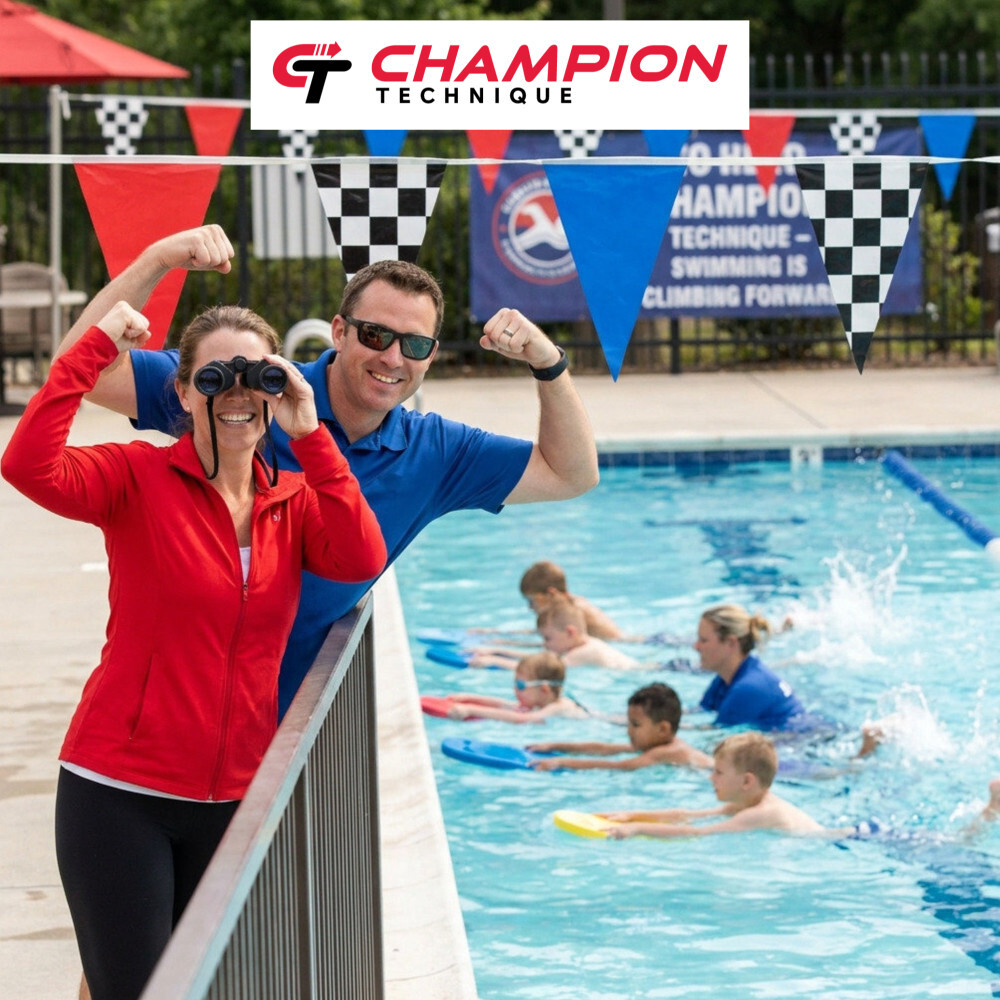
Picture this: You're sitting poolside, watching your child swim during their lesson. Their little arms windmill through the water, coaches shout encouragement, and you think, "They're doing great!"
But here's the truth most parents don't know...
There's ONE simple visual indicator that reveals whether your child is learning proper stroke mechanics or outdated techniques that could limit their speed and power for years to come.
That indicator? A straight, high arm recovery.
Sounds simple, right? But that straight arm swinging high above the water isn't just about looking good - it's a window into what's really happening beneath the surface. It's proof that your swimmer is rotating their body correctly, generating power from their core, and building the foundation of elite swimming technique. Not just for freestyle, but most likely, the rest of the competitive strokes (generating power from the body rotation)
The World's Fastest Swimmers Have Already Made the Switch
Don't just take our word for it. Let's look at the facts:
Australia's Cameron McEvoy holds the men's 50m freestyle world record at 20.88 seconds. His stroke? Straight arm recovery with explosive body rotation.
Sweden's Sarah Sjöström owns the women's 50m freestyle world record at 23.61 seconds. Her technique? Tall, straight arms driven by powerful torso rotation.
These aren't flukes. These aren't exceptions. These are the world record holders—the absolute fastest humans in the water—and they're BOTH swimming with straight arm freestyle.
And here's what should really get parents' attention:
By the 2028 Summer Olympics, experts predict that freestylers will PREDOMINANTLY be swimming with tall, straight arms.
This isn't a trend. This is the evolution of the sport happening right before our eyes.
Why Most Swim Schools and Swim Teams Are STILL Teaching Your Kids Wrong
So if straight arm freestyle is clearly the technique of champions, why are 99% of swim programs still teaching bent elbow recovery?
Because they're teaching based on old assumptions and outdated fears. Swim Schools are actually students of the swimming science. Swim Teams don't tend to have a uniform technique philosophy - each coach brings their own philosophy to the team.
For decades, coaches taught: "Bend your elbow! Keep it low! Don't do straight arm—you'll destroy your shoulders!"
And you know what? They were right... if you swim FLAT on your stomach.
The old bent elbow technique made sense when swimmers were taught to stay flat in the water and "pull" water backward. In that paradigm, straight arm recovery DID create shoulder stress and pain.
But here's what changed everything:
Modern swimmers don't swim flat. They rotate side-to-side.
When you rotate your body properly with each stroke, that rotation takes the tension OFF the shoulders. The stress that would cause pain? It's eliminated because the movement becomes natural, flowing from the hips through the torso and out through the arm.
The straight arm isn't putting stress on anything—it's following the natural torque generated by body rotation.
The Science: Why Straight Arm = Maximum Power
Here's where it gets really exciting for parents who want to understand the "why" behind the technique:
Straight arm freestyle maximizes torque and distance-per-stroke generated from body rotation.
Let me break that down in parent-friendly terms:
When your child rotates their body properly (pushing that top hip DOWN with each stroke), they create a powerful twisting motion through their core. That twist generates torque—rotational force.
Now, imagine your child's arm as a lever. A straight lever creates more reach and more distance than a bent one, right?
Straight arm = longer lever = more distance per stroke
Body rotation = engine that powers the lever
Combination = maximum efficiency and speed
But here's the KEY insight that most coaches miss:
The straight arm isn't the goal—it's the INDICATOR.
You can't force a swimmer to use straight arm recovery if they're swimming flat on their stomach. It's uncomfortable, inefficient, and yes—it would hurt their shoulders.
But when a swimmer is rotating properly, generating power from their hips and core, the straight arm recovery happens NATURALLY. It's the path of least resistance. It's the biomechanically correct movement pattern.
So when you see your child swimming with straight, high arms, you're actually seeing proof that they're rotating correctly and generating power the right way.
Swimming Is Climbing, Not Pulling
At Champion Technique, we've reimagined swimming from the ground up based on a revolutionary paradigm:
Swimming isn't pulling water backward. Swimming is climbing forward through water.
Think about a rock climber scaling a wall:
- They reach as HIGH and FAR as possible to the next hold
- They anchor solidly before applying force
- They LEVER their body upward using their entire core
- They explode between positions with full-body rotation
Elite swimmers like Cameron McEvoy and Sarah Sjöström do the exact same thing - just horizontally through water instead of vertically up rock.
This is the "Climbing Paradigm," and it's at the heart of everything we teach at Champion Technique.
The Coupling Effect: Where Real Power Is Born
Here's where it gets really exciting:
While one arm is reaching FORWARD explosively (that straight, high arm you see above the water), the other arm is pressing BACKWARD beneath the surface. These two movements aren't separate—they're connected through core rotation.
Watch McEvoy or Sjöström swim in slow motion. You'll see:
- Top hip drives DOWN
- Body rotates powerfully side-to-side
- The recovering arm swings HIGH and STRAIGHT
- The pulling arm anchors and leverages
- Everything flows together in one explosive, connected movement
Speed comes from the legs. Power is generated through body rotation. The arms follow the body rotation and stay long.
That's the Champion Technique formula. That's what world record holders do. And that's what we teach from day one.
Our Teaching Progression: Building Champions From Day One
Unlike traditional swim schools and swim teams that focus on just "getting across the pool," we build proper mechanics in a specific order from the very first lesson:
1. Head/Body Position First
Before anything else, we establish the proper body line. You can't build a house on a shaky foundation, and you can't build a champion swimmer with poor body position.
2. Body Rotation Second
This is where the magic happens. We teach swimmers to rotate through their core—driving that top hip down with each stroke. This is where power comes from. This is what generates that beautiful straight arm recovery naturally. This is what protects the shoulders from stress.
3. Stroke Coordination Last
Only after proper rotation is established do we add in the timing and coordination of the full stroke. By this point, the mechanics are already correct - we're just putting the pieces together.
Debunking the "Straight Arm Will Hurt You" Myth
Let's address the elephant in the room—the old warning that kept swimmers from developing proper technique for decades:
MYTH: "Straight arm recovery will destroy your shoulders!"
TRUTH: Straight arm recovery with FLAT body position will cause stress. But straight arm recovery with PROPER BODY ROTATION eliminates shoulder stress entirely.
The problem was never the straight arm. The problem was swimming flat.
When your body rotates side-to-side with each stroke:
- The shoulder naturally lifts out of the water
- The arm follows the body's rotation—not fighting against it
- Tension is distributed through the entire kinetic chain
- The movement becomes fluid, natural, and pain-free
Cameron McEvoy didn't break a world record despite using straight arm freestyle. He broke it BECAUSE of it.
Why This Matters RIGHT NOW for Your Child
Every single day your swimmer practices the OLD way—flat body, bent elbow, "pull the water back"—those inefficient movement patterns become harder to fix.
Bad habits compound.
Muscle memory locks in.
The 8-year-old learning bent elbow recovery today becomes the 14-year-old competitive swimmer struggling to break through plateaus because their foundation is built on outdated mechanics.
They'll hit a speed ceiling. They might develop shoulder pain. They'll watch swimmers with proper technique blow past them and wonder why they can't keep up.
But the opposite is also true:
The earlier your child learns the RIGHT technique—proper rotation, straight arm recovery, climbing paradigm—the faster they reach their full potential.
Think about it: By the time the 2028 Olympics roll around and the swimming world sees nearly every freestyler using tall, straight arms, do you want your child to be ahead of the curve or scrambling to catch up?
That's why at Champion Technique, we don't wait until swimmers are "advanced" to teach elite mechanics. We start teaching proper rotation and the climbing paradigm immediately—even with our youngest swimmers in swim lessons. We carry these principles all the way through competitive swimming.
Because champions aren't built in high school. They're built in those early lessons where foundations are formed.
What To Look For Next Time You're Poolside
Here's your homework, parents:
Next time you watch your child swim, don't just watch if they're "making it across the pool." Look deeper:
- Is my child's arm swinging HIGH and STRAIGHT during recovery?
- Is their body rotating side-to-side with each stroke?
- Is their top hip driving DOWN as they rotate?
- Are they reaching FORWARD explosively, or just moving their arms back and forth?
- Does their stroke look powerful and connected, or disconnected and choppy?
If you're seeing straight, high arms with strong body rotation—celebrate! Your swimmer is learning proper mechanics that will serve them for life.
They're learning the same technique Sarah Sjöström used to set a world record. They're building the foundation for 2028 Olympic-level swimming.
If you're seeing bent elbows, flat body position, and choppy arm movements—it's time to have a conversation with their coach about the technique they're being taught.
Because that straight arm? It's not just style. It's the indicator that tells you everything about what's happening beneath the surface.
Join the Swimming Revolution
The swimming world is changing right before our eyes.
Cameron McEvoy: 20.88 seconds. Straight arm recovery.
Sarah Sjöström: 23.61 seconds. Straight arm recovery.
2028 Olympics: Predicted to showcase predominantly tall, straight arm freestyle.
The evidence is overwhelming. The direction is clear.
At Champion Technique, we're not waiting for the revolution. We're leading it.
We're teaching kids as young as 3 and 4 years old to rotate their bodies properly. We're showing competitive swimmers how to generate explosive torque from pushing that top hip down. We're building a community of swimmers who understand that efficiency, proper mechanics, and power come from the same source: the body's natural ability to climb forward through water.
And we're doing it all while protecting their shoulders, building sustainable technique, and preparing them for the future of competitive swimming.
Want to Master Swimming's Best-Kept Secrets?
Subscribe to Champion Technique's FREE Monthly Stroke Technique Newsletter!
Get cutting-edge insights delivered straight to your inbox:
- Revolutionary technique breakdowns for ALL strokes
- Drills that actually work (and why)
- What elite swimmers like McEvoy and Sjöström know that recreational programs don't teach
- Progressions for every skill level
- Video demos and coaching cues you can use TODAY
Don't let another season go by with your swimmer practicing outdated mechanics. Every stroke matters. Every lesson counts. Every day is an opportunity to build proper technique—or reinforce bad habits.
The choice is yours, parents.
But now you know what to look for. Now you know the indicator. Now you know the truth.
Straight arm recovery means proper body rotation. It also means your athlete is probaly learning how to swim the other competitive strokes correctly too with a powerful body rotation leading the way.
Proper body rotation means maximum power and efficiency.
Maximum power and efficiency means world records—and pain-free swimming for life.
The 2028 Olympics will prove what we already know. The question is: will your child be ready?
