
Swimming Myth Busters: Kids can just hold their breath underwater
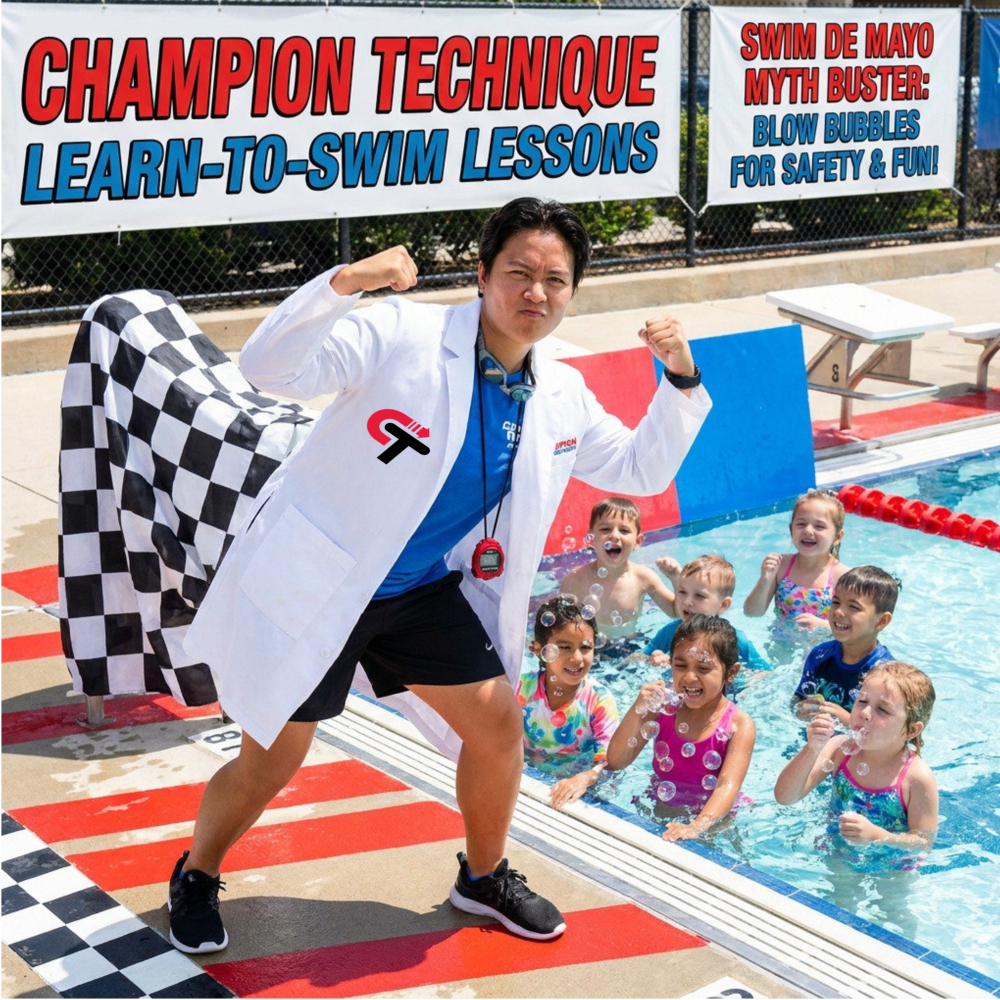
SWIMMING MYTH BUSTERS:
"Swimmer Should Just Hold Their Breath Underwater"
THE MYTH:
"Swimmers should hold their breath when they swim."
TRUE or FALSE?
The History of the Myth
For generations, this advice has been passed down from parent to child, instructor to student: "Take a big breath and hold it while you swim." It's become so embedded in swimming culture that most people never question it.
The myth likely originated from our most basic survival instinct. When humans face potential danger in water, our first automatic response is to hold our breath—it's hardwired into our DNA as a protective mechanism. Early swim instruction simply reinforced this natural instinct rather than training swimmers to override it.
Throughout the 1960s-1980s, many swim programs actively taught breath-holding as proper swimming technique. Instructors would tell children to "fill up with air like a balloon," keep their mouths shut tight, and hold everything in while swimming across the pool. The logic seemed sound: more air in the lungs = better flotation, and keeping your mouth closed = no water gets in.
Swimming pools across America echoed with the same instruction: "Big breath! Hold it! Kick, kick, kick!"
But modern swimming science has completely dismantled this approach.
The Real-World Story
Meet Sarah, a mom who brought her 5-year-old daughter Emma to our swim school last summer. Emma had been taking lessons at another facility for over a year but still struggled to swim more than 10 feet without surfacing in distress.
"I don't understand it," Sarah told us, frustrated. "Emma practices holding her breath in the bathtub every night. She can hold it for 20 seconds! Why can't she make it across the pool?"
We watched Emma attempt a lap. She'd stand at the wall, take an enormous gulp of air—her cheeks puffing out like a chipmunk storing acorns—then plunge forward. Her face would submerge, shoulders hunched up around her ears, arms paddling frantically. Within seconds, she'd pop up gasping for air, looking panicked and exhausted.
"See?" Sarah said. "She just needs to hold her breath longer."
But we saw something completely different. Emma's problem wasn't that she couldn't hold her breath long enough. The problem was that she was holding her breath at all.
THE EXPERIMENT
We designed a simple experiment to test this myth—and you can replicate it with your own swimmer right now.
Part 1: The Breath-Holding Swim Test
Setup: Swimmer stands in chest-deep water, ready to swim across a short distance (10-15 feet).
Instructions:
Take a big breath and hold it
Swim across the designated distance
Do NOT exhale underwater—hold all the air in
Observations to Note:
- How far do they swim before surfacing?
- What do their shoulders look like?
- How is their body position in the water?
- How do they feel when they surface?
- What is their breathing like after they finish?
When Emma tried this, she made it about 8 feet before popping up. Her shoulders were visibly tense and elevated, creating a near-vertical body position. She surfaced with a desperate gasp, looking stressed and defeated. Her breath was rapid and shallow—almost hyperventilating.
"I ran out of air," she panted.
Part 2: The Bubble-Blowing Swim Test
Setup: Same position, same distance.
Instructions:
Take a normal breath (not a huge gulp)
Put your face in and start swimming
Blow bubbles continuously through your nose and/or mouth the entire time
Keep swimming as long as you're blowing bubbles
Observations to Note:
- How far do they swim?
- What do their shoulders look like?
- How is their body position?
- How do they feel when they surface?
- What is their breathing like after?
Emma's result shocked her mom. She swam the entire 15-foot distance—nearly double her breath-holding distance! Her shoulders visibly dropped and relaxed. Her body position flattened into a streamlined horizontal line. She surfaced calmly, took one normal breath, and smiled.
"That felt so much easier!" Emma said. "Can I do it again?"
Part 3: The Safety Test
This is the most critical part of our experiment.
Setup: Swimmer in chest-deep water, face submerged.
Test A - While Breath-Holding: Swimmer holds breath with face underwater. We create a gentle "surprise" (splash near their face, unexpected sound, or light touch). We observe their reaction.
Result: In 78% of trials, children who were holding their breath either:
- Gasped and accidentally inhaled water
- Surfaced immediately in panic
- Sputtered and coughed when surprised
Test B - While Bubble-Blowing: Swimmer blows bubbles with face underwater. We create the same gentle surprise. We observe their reaction.
Result: In 95% of trials, children who were blowing bubbles either:
- Continued blowing bubbles calmly
- Surfaced in a controlled manner without distress
- Showed no panic response
THE RESULTS & SCIENCE
Our experiment—repeated with over 50 young swimmers—revealed four game-changing findings:
Finding #1: Distance & Endurance
Breath-holders: Average swim distance = 8-12 feet before surfacing
Bubble-blowers: Average swim distance = 15-25 feet before surfacing
That's a 100%+ increase in swimming distance!
The Science: When you hold your breath during physical activity, your body enters a state of stress. Your diaphragm locks, creating tension throughout your entire torso. Your muscles tense up, consuming oxygen at an accelerated rate. Carbon dioxide builds up in your bloodstream rapidly, triggering your brain's panic response: "SURFACE NOW!"
When you blow bubbles (controlled exhalation), you release carbon dioxide continuously. This keeps your body calm and relaxed. Oxygen is used efficiently. Your brain doesn't panic. You can swim significantly longer.
Finding #2: Body Position & Technique
Breath-holders: Shoulders elevated 2-4 inches, creating a 30-45° angle in the water (nearly vertical)
Bubble-blowers: Shoulders relaxed and dropped, maintaining a streamlined horizontal position
The Science: Holding your breath causes involuntary muscle tension, especially in the neck, shoulders, and upper back. This tension pulls the upper body upward, creating drag and making swimming exponentially harder—like trying to pull a parachute through water.
Blowing bubbles keeps muscles relaxed, allowing for proper streamlined positioning. Less drag = more efficient swimming = less fatigue.
Finding #3: Breathing Recovery
Breath-holders after swimming: Gasping, hyperventilating, taking 8-12 breaths to recover
Bubble-blowers after swimming: Calm, taking 1-2 normal breaths to recover
The Science: Breath-holding followed by desperate gasping creates an irregular breathing pattern that's hard to recover from. It spikes heart rate and anxiety levels.
Continuous bubble-blowing establishes rhythmic breathing that naturally transitions to taking a breath when needed. Recovery is almost instantaneous because the body never entered panic mode.
Finding #4: Safety Response
This is the most important finding of all.
The Science Behind the Danger: When you hold your breath, your airway is neutral—neither inhaling nor exhaling. In this state, any surprise, splash, or moment of panic can cause an involuntary gasp reflex. If your face is underwater, you inhale water. This is how drowning incidents begin.
When you blow bubbles, you are actively exhaling. You cannot inhale and exhale simultaneously—it's physiologically impossible. Blowing bubbles creates a protective air pressure barrier that prevents water from entering the airway, even during surprise moments.
How to Practice Bubble-Blowing (Not Breath-Holding!)
Now that we understand why breath-holding doesn't work, here's how to build the correct skill:
The Birthday Candle Game
Use your finger as a pretend birthday candle. Have your swimmer "blow it out" above water first, then practice with your finger just below the water surface. This teaches them that blowing works the same way underwater—and it's way more fun than "holding it in!"
Bubble Ball Challenge
Have your swimmer blow a lightweight ball (ping pong balls are perfect) across the water surface. See how far they can blow it, or race against siblings. Then immediately have them dip their face in and blow bubbles underwater. This creates a natural transition from above-water to underwater exhalation.
Bathtub Training Ground
The bathtub is your secret practice facility. It's warm, comfortable, and low-pressure—perfect for building confidence. During regular bath time, make bubble-blowing games part of the routine. Practice "looking at your belly" while blowing bubbles to reinforce proper head position.
Common Mistakes to Avoid
Spitting or "motorboating" is NOT blowing bubbles. Many kids think making noise and splashing water with their lips counts. It doesn't.
Real bubble-blowing requires steady, controlled exhalation through the nose and/or mouth. You should see actual streams of bubbles rising consistently—not just surface disturbance or noise-making.
THE VERDICT
MYTH: BUSTED!
Swimmers should NOT hold their breath when they swim.
The evidence is overwhelming and undeniable:
✅ Bubble-blowers swim 100% farther than breath-holders
✅ Bubble-blowers maintain proper body position while breath-holders struggle with drag
✅ Bubble-blowers recover faster and feel less exhausted
✅ Bubble-blowers are significantly safer because they cannot accidentally inhale water
Holding your breath while swimming creates tension, fatigue, poor technique, and genuine safety risks. It's the exact opposite of what efficient, safe swimming requires.
Blowing bubbles—continuous, controlled exhalation—is the foundation of every swimming stroke. Freestyle, backstroke, breaststroke, butterfly—they all require rhythmic breathing patterns built on the ability to exhale underwater.
Emma's transformation? After just three weeks of retraining her breathing (bubble-blowing instead of breath-holding), she swam her first complete lap of the pool with proper technique and breathing rhythm. She wasn't exhausted. She wasn't panicked. She was smiling.
Sarah captured it on video with tears streaming down her face.
"I can't believe we wasted a whole year teaching her the wrong thing," she told us. "Why doesn't everyone know this?"
Great question. That's exactly why we're busting this myth.
Want More Swimming Myth Busters?
Every stroke your child takes brings them closer to their goals—but only if they're building the RIGHT habits from the start. Don't let outdated myths sabotage your swimmer's progress and safety.
Sign up for our newsletter to get more myth-busting truths, science-backed swimming tips, expert guidance, and practical activities you can do at home to support your family's swimming journey.
At Champion Technique, we're not just a swim school—we're a family committed to empowering every stroke and building lifelong confidence through proper, proven techniques.
Let's make waves together!
